
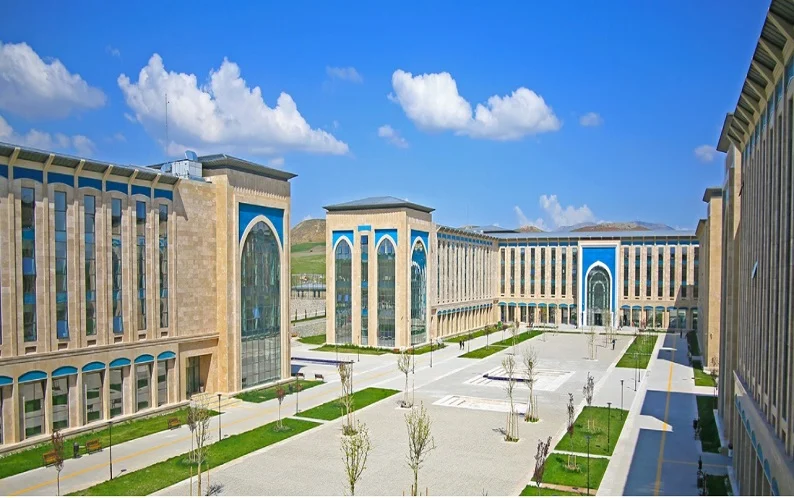
History and Vision of the University
Ankara Yıldırım Beyazıt University (AYBU) was established in Ankara on July 21, 2010, by Law No. 27648. As the capital’s fifth public university, AYBU is named after Yıldırım Bayezid, the second sultan of the Ottoman Empire. The university admitted its first students in the 2011–2012 academic year, starting with 7 faculties, 1 school, 4 institutes, and 1 conservatory. Under the leadership of Rector Prof. Dr. Ali Cengiz Köseoğlu (since April 25, 2023), the university adopts the vision of “scientific leadership and social contribution.” Its mission is to educate innovative individuals through education and research at international standards. With nearly 20,000 students (YÖK Atlas, 2022–2023), it is ranked in the 1001–1200 band by Times Higher Education for 2025. AYBU stands out with its internationalization goals, having over 10% international students.
Education
Ankara Yıldırım Beyazıt University offers a broad academic range with 15 faculties, including: Medicine, Law, Political Science, Engineering and Natural Sciences, Health Sciences, Islamic Studies, Business, Humanities and Social Sciences, Dentistry, Architecture, Aviation and Space Sciences, Fine Arts, Sports Sciences, Psychology and Sociology, and Applied Sciences. The university also includes 5 institutes (Science, Health, Social Sciences, Islamic Studies, International Relations and Strategic Research), 1 school (School of Foreign Languages), 3 vocational schools, and 1 conservatory. In total, there are over 100 undergraduate and 150 graduate programs. Programs such as Medicine and Computer Engineering stand out for being taught in English. With around 1,100 academic staff, education is provided both theoretically and practically. More than 70 laboratories and 24 research centers (e.g., GETAT Center) support scientific studies. AYBU is actively involved in TÜBİTAK-funded projects.
For more information, visit the official website of Ankara Yıldırım Beyazıt University.
Campus and Technological Infrastructure
The main campus of AYBU is the Esenboğa Complex, which spans 1,200 acres. Additional campuses include Etlik West and East, and the Faculty of Medicine located in Bilkent. With a total of 250,000 m² of indoor space, the campuses are designed with modern architecture and advanced technology. High-speed internet and smart classrooms form the core of its educational infrastructure. The library offers access to over 74,000 printed resources and more than 1 million digital publications, with a seating capacity of 1,000. The Faculty of Medicine provides hands-on training through cooperation with Ankara Bilkent City Hospital. The campuses are equipped with state-of-the-art laboratories and research centers, boosting scientific productivity through strong technological infrastructure.
Student Housing
AYBU provides student housing in cooperation with KYK (Credit and Dormitories Institution). Around Esenboğa and Etlik campuses, there are more than 5,000 beds available. Rooms accommodate 2 to 6 students and are furnished with beds, wardrobes, desks, and internet access. Dormitories also include laundries, kitchens, and study rooms. Security is ensured with 24/7 camera systems, and regular cleaning is maintained. Canteens meet basic needs. Applications are made through the KYK online system, with priority given to scholarship and international students. The proximity of dormitories to the campuses provides convenience.
Social Life
AYBU offers a vibrant social life. The green spaces and modern facilities of the Esenboğa Campus provide a peaceful environment. Sports facilities include basketball courts, volleyball areas, and fitness centers, with student teams participating in tournaments. Dining halls provide daily meals, though vegan options are limited. There are over 40 student clubs (such as the Middle East Research Club and Robotics Society) that organize concerts, exhibitions, and the annual “Spring Festival.” The university’s central location in Ankara enhances access to cultural events. Social activities are also held to help international students integrate.
International students interested in life in Turkey can visit the Road to Study platform for more information.
Cultural Adaptation for International Students
AYBU hosts over 2,700 international students from more than 110 countries. The International Relations Office provides visa support and orientation programs. Turkish language courses are offered through TOMER, and around 40% of the education is in English. Through Erasmus+ and bilateral agreements, AYBU collaborates with over 200 universities. “International Day” events promote cultural exchange. A mentoring system helps new students integrate into campus life. The university’s location in Ankara, Turkey’s capital, offers international students a unique cultural and academic experience.
Health Services and Safety
Health services are available on campus through university Health Centers, offering weekday medical consultations and emergency care. Ambulance service is available 24/7. The Faculty of Medicine collaborates with Bilkent City Hospital. Psychological counseling is provided through individual therapy sessions, with appointments made online. Campus safety is ensured with round-the-clock surveillance cameras and personnel; entrances and exits are monitored. Fire drills are regularly conducted to maintain safety standards.
Transportation
The Esenboğa Campus is located 30 kilometers from the city center and can be reached via the EGO 474 express line and minibuses. The Etlik campuses are 10 kilometers from the center and are easily accessible by bus and metro. Free shuttle services operate within the campuses. Bicycle paths and parking areas are available. The campus is only 5 kilometers from Esenboğa Airport, and public transportation is offered at discounted rates for students.
Student Support Services
AYBU offers various student support services through its Career Center, which provides internship and job opportunities and organizes “Career Days.” Academic advisors guide students in their academic journey. The Psychological Support Unit offers free therapy sessions. The Disabled Student Office provides accessibility arrangements. The Scholarship Office coordinates student financial aid. A mentoring program supports academic and social integration.